
Breaking habits
Thumb sucking, lip biting or tongue thrusting – so-called habits – are specifically broken before they deform the dentition.

Treating children calls for empathy, trust and a pleasant atmosphere in the practice. With early, regulating therapy you can spare your child more extensive measures later on.
Treating children calls for a great deal of empathy, trust and a pleasant atmosphere in the practice. We take our time so that your child feels at ease with us.
An early and regular check-up makes it possible to determine the ideal moment to start treatment on a completely individual basis – this allows us to respond effectively to growth-related changes in the dentition.
The teeth and jaws of children and teenagers are developing permanently. A particularly critical period, in which check-ups by the orthodontist and the start of therapy are sensible and important, is the phase of the change of teeth.
The earlier a developmental disorder is recognised, the faster, more effective and gentler its correction usually is.
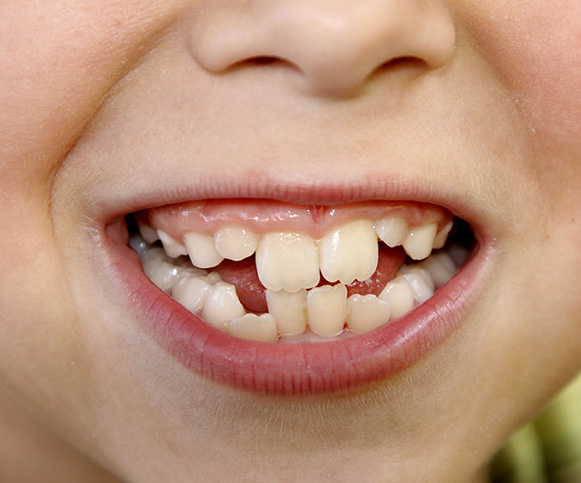
We recommend having the functional capability of a child's dentition examined in good time. Irregularities in the milk dentition often already point to problems in the permanent dentition. With some misaligned teeth it is advisable to begin the correction while the milk teeth are still in place.
Initial orthodontic check-ups can be sensible from the age of three to five, because at this age the milk teeth are all present and misalignments as well as dysfunctions are already recognisable.
A short course of therapy is advisable, for example, if a child lisps, has sucked its thumb for a longer period or has used a dummy for a long time.
With early, regulating therapy you can spare your child more extensive measures later on.
Thumb sucking, lip biting or tongue thrusting – so-called habits – are specifically broken before they deform the dentition.
An open bite in the front tooth region can often still be corrected in the milk dentition without great effort.
A crossbite is resolved at an early stage, both in the posterior and in the anterior region.
If a milk tooth is lost prematurely, a space maintainer keeps the gap free for the tooth that follows.
If the jaw is too small for the teeth that follow, we create the necessary space in good time.
Additionally formed teeth are detected and treated in consultation with your dentist.

The transitional phase in which milk teeth are replaced by the permanent teeth that follow is called the mixed dentition. If there were no particular findings in the milk dentition, the ideal age for the first orthodontic examination is eight to nine years.
In this phase, therapeutic steps are usually taken with removable braces such as single plates or functional orthodontic appliances, a bionator for example.
In a holistically oriented approach to orthodontics we make use of the expected pubertal growth spurt, with the development of the facial bones, in order to optimise the aesthetic appearance.