
The advantages of transparent plastic aligners
From an orthodontic point of view, the term “invisible brace” refers to treatment with transparent aligners. Misaligned teeth can be corrected with these transparent, barely visible aligners.
Removable transparent braces have proved their worth at our specialist orthodontic practice. Adult and teenage patients appreciate the discreet correction with what are known as aligners.
In principle, a plastic aligner works like a conventional brace: the teeth are moved step by step into the intended position. In this way misaligned teeth can be corrected at almost any age without major restrictions in everyday life.
Another advantage is how easy they are to care for: the aligners can be taken out at any time for eating, drinking and cleaning the teeth.
Why patients choose aligners
Four reasons in favour of a correction with transparent plastic aligners.
Discreet correction
The transparent, virtually invisible aligners are hardly noticed in everyday life and allow an elegant correction without attracting attention.
High wearing comfort
The wafer-thin aligners fit precisely, are pleasant to wear and do not get in the way when speaking or laughing.
Gentle treatment
In contrast to conventional fixed braces, aligner therapy is virtually free of pressure and pain.
Practical in everyday life
The aligners can be taken out of the mouth at any time for eating, drinking or dental care.
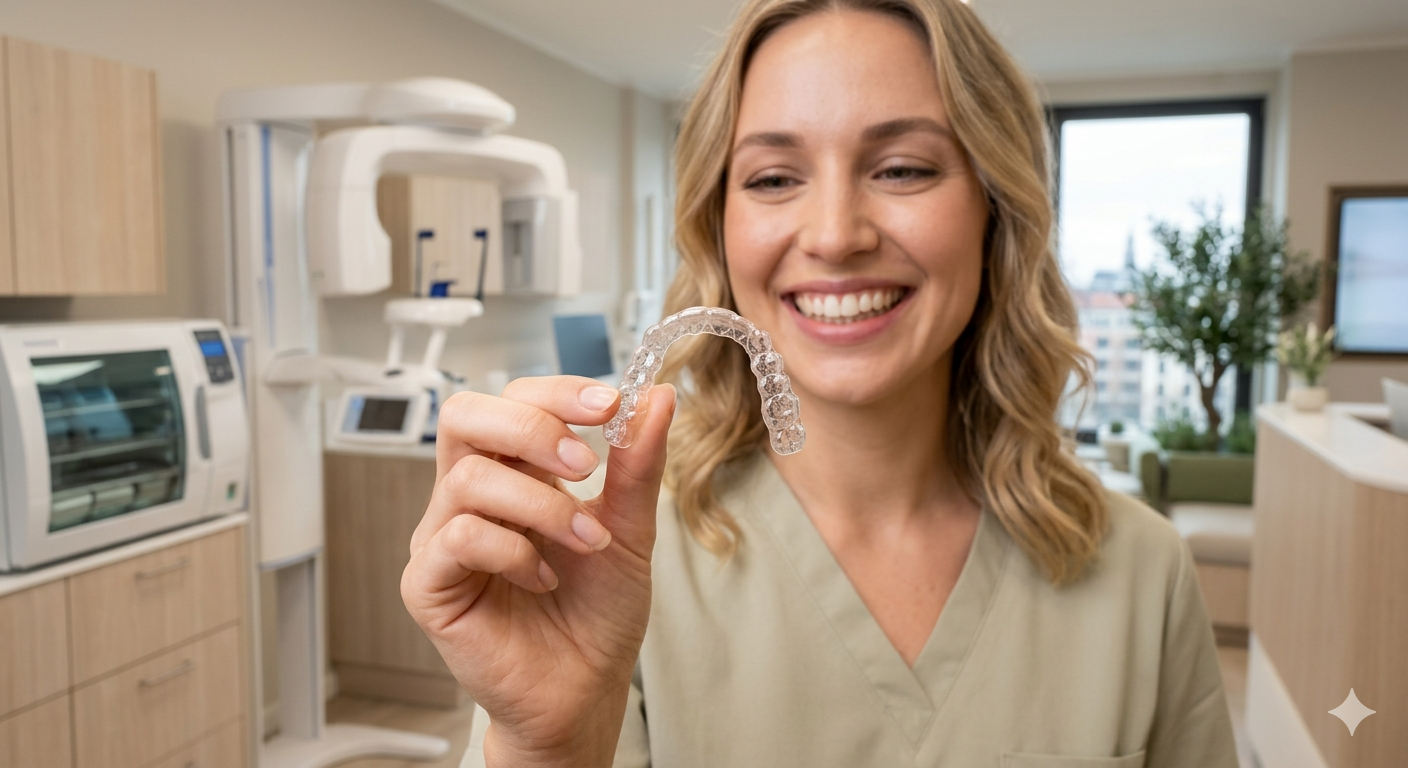
Clear braces – almost imperceptible to other people
Correcting teeth with aligners is a clinically documented procedure for straightening teeth. It follows the same biomechanical principles as treatment with a classic removable appliance or brackets – but is felt by many patients to be noticeably more pleasant.
The range of applications is wide: mild to moderate misalignments and narrow gaps can be corrected reliably. This makes the aligners suitable for simple as well as for more demanding starting situations.
Which option is right for you is something we clarify after recording the findings – do get in touch.
The key facts at a glance
- From an orthodontic point of view, the term “invisible brace” refers to treatment with transparent aligners.
- Aligners move the teeth according to the same biomechanical principles as a conventional plate or brackets.
- Frequently cited advantages: discreet correction, high wearing comfort, almost pressure-free treatment, removable in everyday life.
- The range of application covers mild to moderate misalignments of the teeth and narrow gaps between teeth.
- Whether aligners are an option is decided by the clinical examination in the specialist practice.